地球资源数据云——数据资源详情
影响儿童贫血水平的因素
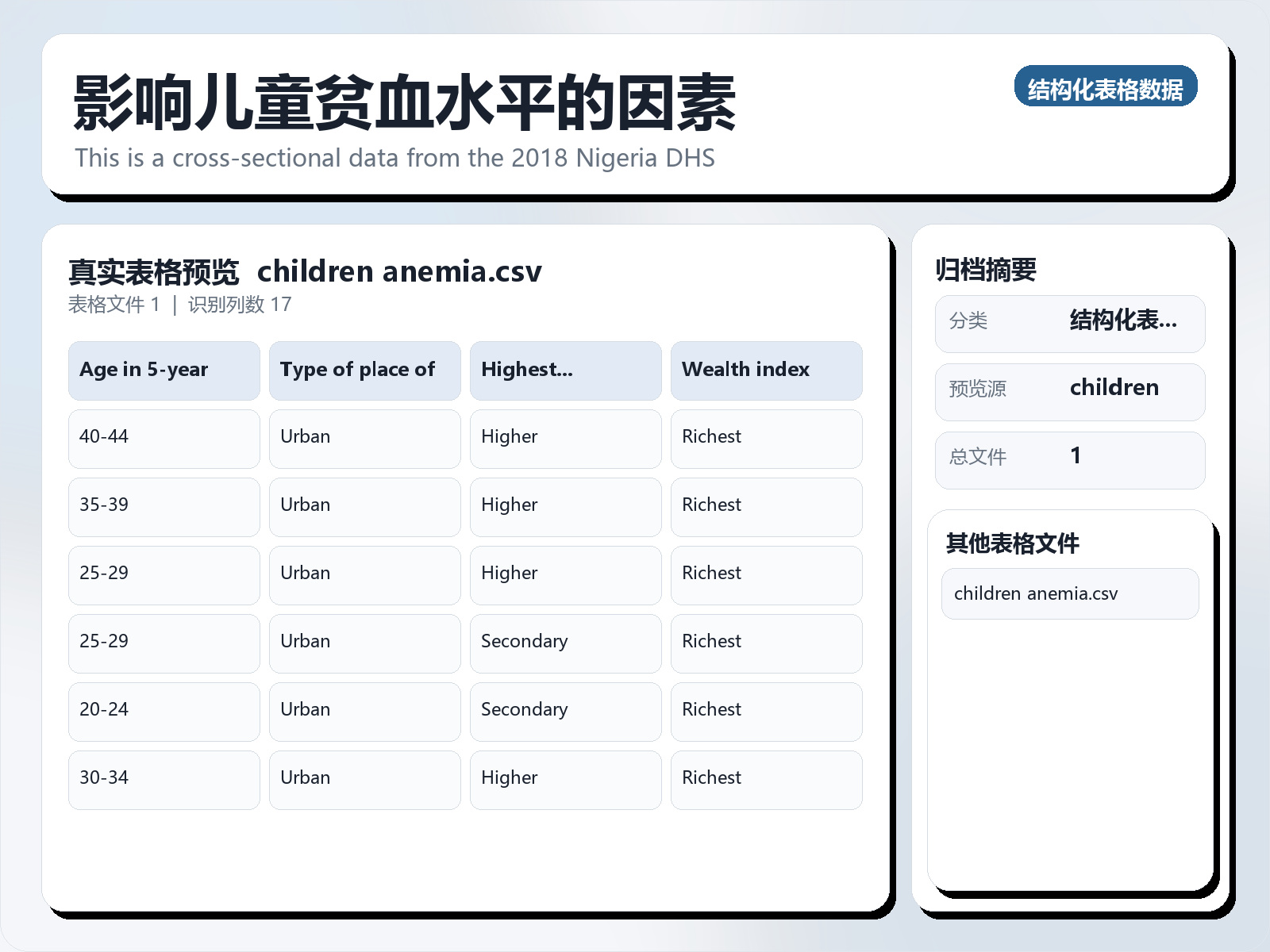
该数据集《Factors Affecting Children Anemia Level》主要用于回归/预测任务,数据形态以表格为主,应用场景偏向医疗健康。 题目说明:This is a cross - sectional data from the 2018 Nigeria DHS 任务类型:表格回归/预测。 建议流程:先做缺失值/异常值处理与特征编码,再比较逻辑回归、随机森林、XGBoost。 评估建议:使用分层切分或交叉验证,优先关注 F1、Recall、AUC 等分类指标。 可用文件:children anemia.csv。 In this study, cross - sectional data from the 2018 Nigeria Demographic and Health Surveys (NDHS) were collected to answer research questions about the effect of mothers' age and other socioeconomic factors on children aged 0 - 59 months anemia level in Nigeria. DHS are cross - sectional, nationally representative household surveys that are typically conducted every 5 years. This survey data considered the 36 states of Nigeria, as well as the Federal Capital Territory (FCT). The targeted population in this study are children aged 0 - 59 months and mothers aged 15 - 49 years. In this survey, household income was measured using the wealth index, current age in 5 - year groups is produced by grouping current age in completed years, type of place of residence where the respondent was interviewed as either urban or rural, the categorization was created based on whether the cluster or sample point number is defined as urban or rural, highest level of education attained is a standardized variable that provides level of education in the following categories: No education, Primary, Secondary, and Higher education, total number of births in the last five years is defined as all births in the months 0 to 59 preceding the month of interview,where month 0 is the month of interview, the respondent's age at first birth is calculated using the CMC of the respondent's date of birth.
摘要概览
该数据集《Factors Affecting Children Anemia Level》主要用于回归/预测任务,数据形态以表格为主,应用场景偏向医疗健康。 题目说明:This is a cross - sectional data from the 2018 Nigeria DHS
任务类型:表格回归/预测。
建议流程:先做缺失值/异常值处理与特征编码,再比较逻辑回归、随机森林、XGBoost。
评估建议:使用分层切分或交叉验证,优先关注 F1、Recall、AUC 等分类指标。
可用文件:children anemia.csv。
In this study, cross - sectional data from the 2018 Nigeria Demographic and Health Surveys (NDHS) were collected to answer research questions about the effect of mothers' age and other socioeconomic factors on children aged 0 - 59 months anemia level in Nigeria.
DHS are cross - sectional, nationally representative household surveys that are typically conducted every 5 years. This survey data considered the 36 states of Nigeria, as well as the Federal Capital Territory (FCT). The targeted population in this study are children aged 0 - 59 months and mothers aged 15 - 49 years.
In this survey, household income was measured using the wealth index, current age in 5 - year groups is produced by grouping current age in completed years, type of place of residence where the respondent was interviewed as either urban or rural, the categorization was created based on whether the cluster or sample point number is defined as urban or rural,
highest level of education attained is a standardized variable that provides level of education in the following categories: No education, Primary, Secondary, and Higher education, total number of births in the last five years is defined as all births in the months 0 to 59 preceding the month of interview,where month 0 is the month of interview, the
respondent's age at first birth is calculated using the CMC of the respondent's date of birth.
常见问题
影响儿童贫血水平的因素是什么?
该数据集《Factors Affecting Children Anemia Level》主要用于回归/预测任务,数据形态以表格为主,应用场景偏向医疗健康。
影响儿童贫血水平的因素是什么数据格式?坐标系是什么?
数据格式为 CSV。
影响儿童贫血水平的因素是如何生产或处理的?
In this study, cross - sectional data from the 2018 Nigeria Demographic and Health Surveys (NDHS) were collected to answer research questions about the effect…
如何获取并引用影响儿童贫血水平的因素?
在本页登录后即可下载。建议引用格式:地球资源数据云. 影响儿童贫血水平的因素. https://www.gis5g.com/dataset/2032002087658098689