地球资源数据云——数据资源详情
世界各地教育不平等
该数据集《Inequality in Education Around the World》主要用于监督学习任务,数据形态以图像为主,应用场景偏向交通/汽车。 题目说明:Examining Global Disparities in Educational Opportunities 任务类型:图像监督学习。 建议流程:先检查类别分布与脏样本,再用迁移学习(如 ResNet/EfficientNet)建立基线。 评估建议:使用分层切分或交叉验证,优先关注 F1、Recall、AUC 等分类指标。 可用文件:Inequality in Education.csv。 Context In today's interconnected world, the issue of inequality in education stands as a stark reminder of the disparities that persist across countries and communities. While strides have been made to improve access to education, a significant proportion of children still lack the opportunity to learn, particularly in low - income and conflict - affected regions. Quality of education also diverges, with well - equipped schools in affluent areas contrasting with under - resourced institutions in marginalized settings. Gender inequality further compounds the problem, as cultural norms and economic factors often impede girls' education in certain societies. Tackling inequality in education isn't just a matter of fairness; it's a critical step towards building equitable societies and empowering individuals to contribute meaningfully to their own development and that of their nations. Content
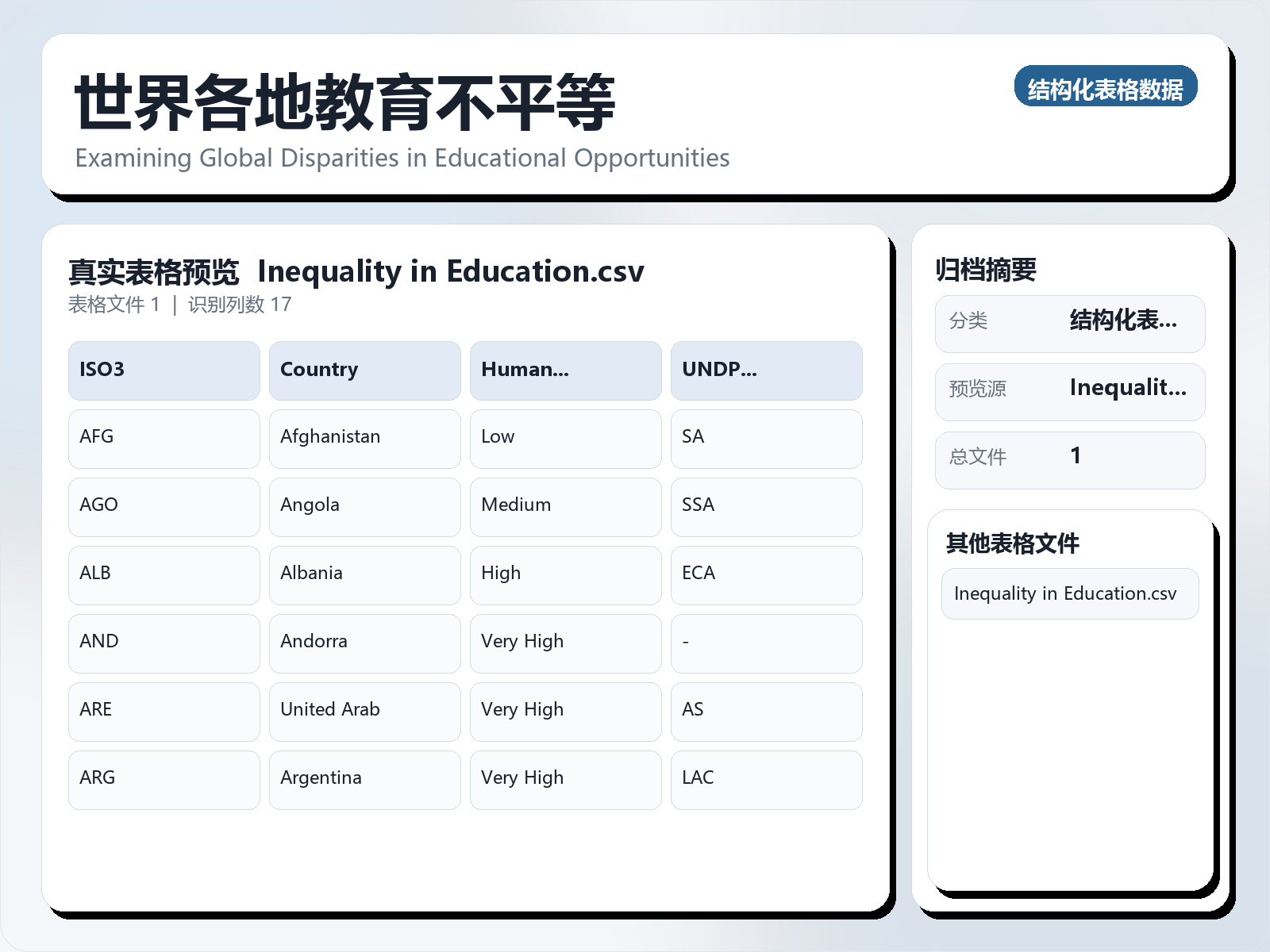
摘要概览
该数据集《Inequality in Education Around the World》主要用于监督学习任务,数据形态以图像为主,应用场景偏向交通/汽车。 题目说明:Examining Global Disparities in Educational Opportunities
任务类型:图像监督学习。
建议流程:先检查类别分布与脏样本,再用迁移学习(如 ResNet/EfficientNet)建立基线。
评估建议:使用分层切分或交叉验证,优先关注 F1、Recall、AUC 等分类指标。
可用文件:Inequality in Education.csv。
Context
In today's interconnected world, the issue of inequality in education stands as a stark reminder of the disparities that persist across countries and communities. While strides have been made to improve access to education, a significant proportion of children still lack the opportunity to learn, particularly in low - income and conflict - affected regions.
Quality of education also diverges, with well - equipped schools in affluent areas contrasting with under - resourced institutions in marginalized settings. Gender inequality further compounds the problem, as cultural norms and economic factors often impede girls' education in certain societies.
Tackling inequality in education isn't just a matter of fairness; it's a critical step towards building equitable societies and empowering individuals to contribute meaningfully to their own development and that of their nations.
Content
常见问题
世界各地教育不平等是什么?
该数据集《Inequality in Education Around the World》主要用于监督学习任务,数据形态以图像为主,应用场景偏向交通/汽车。
世界各地教育不平等是什么数据格式?坐标系是什么?
数据格式为 CSV。
世界各地教育不平等覆盖什么区域?
该数据集覆盖范围为全球。
如何获取并引用世界各地教育不平等?
在本页登录后即可下载。建议引用格式:地球资源数据云. 世界各地教育不平等. https://www.gis5g.com/dataset/2031919227391610881