地球资源数据云——数据资源详情
声纳数据
该数据集《Sonar data》主要用于监督学习任务,数据形态以图像为主,应用场景偏向环保分类。 题目说明:"Exploring the Depths: Unveiling the World Below with Sonar Data" 任务类型:图像监督学习。 建议流程:先检查类别分布与脏样本,再用迁移学习(如 ResNet/EfficientNet)建立基线。 评估建议:使用分层切分或交叉验证,优先关注 F1、Recall、AUC 等分类指标。 可用文件:sonar data.csv。 Sonar data, short for Sound Navigation and Ranging, is a fascinating technology used primarily in underwater environments. It works by emitting sound waves and analyzing the echoes that bounce back from objects, creating detailed maps or images of the underwater terrain. Sonar is crucial for various applications, including underwater navigation, marine exploration, fishing, and military purposes. It comes in different forms, such as active sonar, which emits pulses of sound, and passive sonar, which listens for sounds generated by objects in the water. Sonar data provides valuable insights into underwater topography, the presence of underwater objects, marine life, and even the seabed composition. However, it also raises concerns about its impact on marine ecosystems, particularly its potential to disrupt marine life through noise pollution. As technology advances, sonar data continues to evolve, offering increasingly detailed and accurate information about the underwater world.
摘要概览
该数据集《Sonar data》主要用于监督学习任务,数据形态以图像为主,应用场景偏向环保分类。 题目说明:"Exploring the Depths: Unveiling the World Below with Sonar Data"
任务类型:图像监督学习。
建议流程:先检查类别分布与脏样本,再用迁移学习(如 ResNet/EfficientNet)建立基线。
评估建议:使用分层切分或交叉验证,优先关注 F1、Recall、AUC 等分类指标。
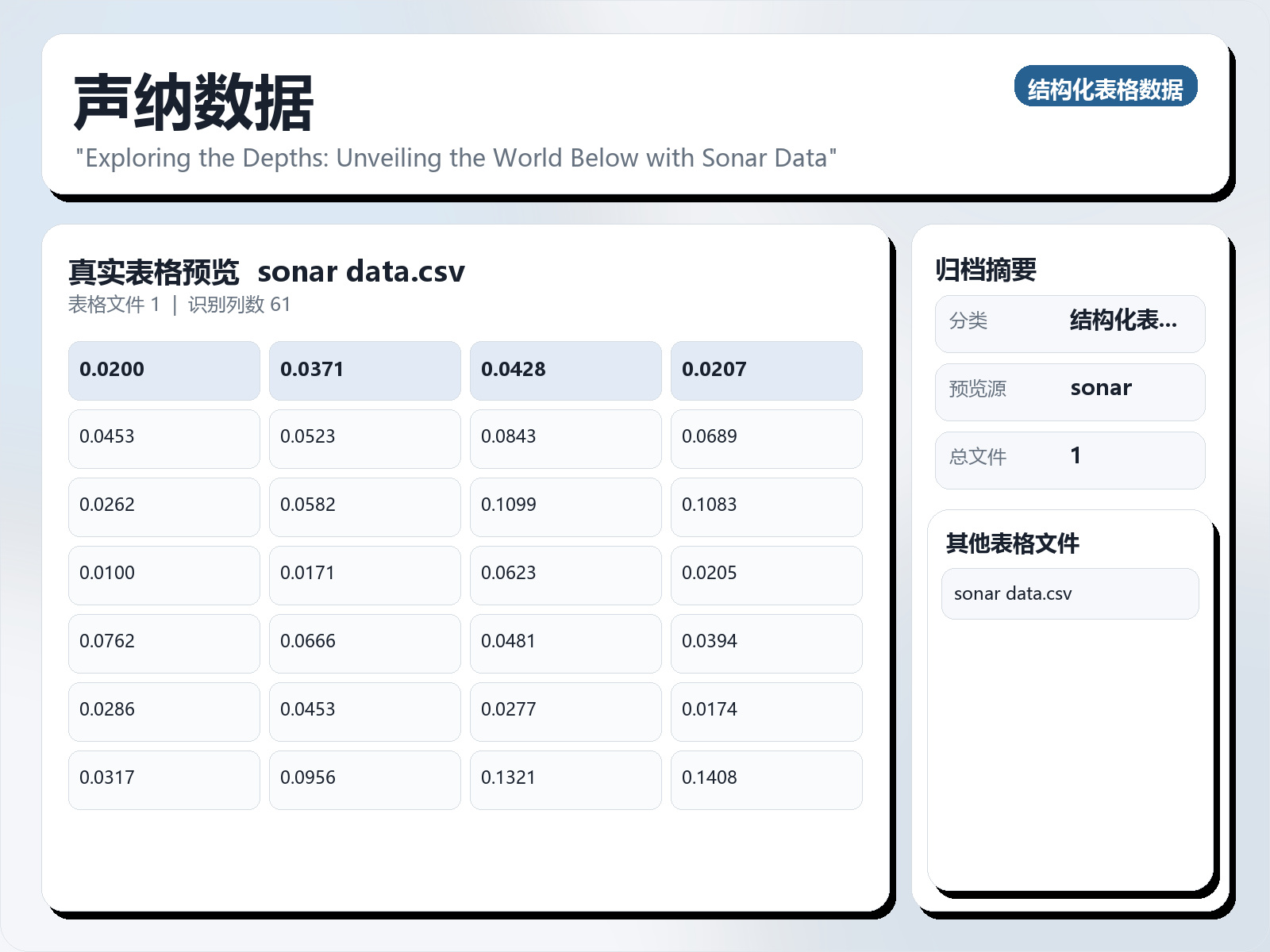
可用文件:sonar data.csv。
Sonar data, short for Sound Navigation and Ranging, is a fascinating technology used primarily in underwater environments. It works by emitting sound waves and analyzing the echoes that bounce back from objects, creating detailed maps or images of the underwater terrain.
Sonar is crucial for various applications, including underwater navigation, marine exploration, fishing, and military purposes. It comes in different forms, such as active sonar, which emits pulses of sound, and passive sonar, which listens for sounds generated by objects in the water.
Sonar data provides valuable insights into underwater topography, the presence of underwater objects, marine life, and even the seabed composition. However, it also raises concerns about its impact on marine ecosystems, particularly its potential to disrupt marine life through noise pollution.
As technology advances, sonar data continues to evolve, offering increasingly detailed and accurate information about the underwater world.
常见问题
声纳数据是什么?
该数据集《Sonar data》主要用于监督学习任务,数据形态以图像为主,应用场景偏向环保分类。
声纳数据是什么数据格式?坐标系是什么?
数据格式为 CSV。
声纳数据是如何生产或处理的?
It comes in different forms, such as active sonar, which emits pulses of sound, and passive sonar, which listens for sounds generated by objects in the water.
如何获取并引用声纳数据?
在本页登录后即可下载。建议引用格式:地球资源数据云. 声纳数据. https://www.gis5g.com/dataset/2031262127132938241